
SEO - Adding Schema Markup
What Is Schema Markup?
Schema markup is a type of on-page SEO technique that entails integrating structured data vocabulary into your website to give search engines a better understanding of the relationships and meaning behind certain entities that are stated there.
A search engine's algorithm aids in accurately identifying the material. The algorithm will understand the webpage data and the entities' connections. After giving the content a structure, Schema enters the picture.

Advantages of Adopting Schema Markup
Implementing Schema allows you to qualify for rich snippets, placing your page at the top of SERPs which can increase website traffic by drawing potential customers or providing brand recognition for product-based brands.
Rich snippets include results that appear above SERPs and provide users with more information than the URL or meta description.
The website's call to action (CTA) increases with the page's SERP ranking.
Different Varieties of Schema Code Languages
The three programming languages for inserting schema markup into web documents are "Json-LD", Microdata & RDFA.
JavaScript Object Notation for Linked Data (JSON-LD)
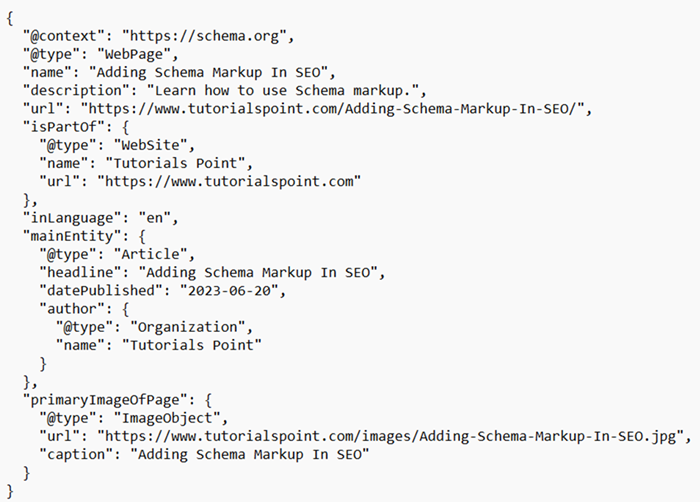
The most prevalent schema format for SEO is JSON-LD, which we will utilise in this article. This code is simpler to create because it may be inserted anywhere in the webpage's HTML body. Since JSON-LD is simple to read and add or remove, Google, which controls 92.24% of the market share for search engines, prefers it wherever possible. It's simple to set up and maintain, and it lets you add several schema types on just one page, which is excellent for helping search engines comprehend your site. Attributes in JSON-LD include @context and @type.
The JSON-LD Schema Code reads as follows −
Microdata
Microdata marks HTML tags to make them more machine friendly and readable. They are easier to use but can get messy since they must be included with every HTML tag within the document's body. They have features such as itemscope, itemtype, and itemprop.
"Resource Description Framework in Attributes (RDFA)"
Microdata and RDFA need distinct HTML elements within the page's body, and their uses are comparable. Typeof, Property, About, and Datatype are several characteristics used in RDFA.
NOTE: there are different types of schema Markups
Steps to Add Schema Markup On a Website for SEO
1. Construct the Schema code
Manually generate the Schema Markup code
The steps to add Schema Markup manually are as follows −
Step 1: Assess the types of schema markup required for your content and select the appropriate schema format or language among the three options listed above. In this piece, we will use Article and JSON-LD, respectively.
Step 2: Construct the code for your schema. We will employ the code shown in Picture 1.
Generate the Schema Markup code using a Schema Generator
Suppose all of the manually entered code for Schema Markup seems challenging or time-intensive. In that case, you can always use tools like Merkle's Schema Markup Generator or another comparable service to automate most of the process.
Step 1: Launch Your Preferred Markup Generator
In the next section, we will use the Merkle Schema Markup Generator.
Conclusion
You only have a few seconds to grab a user's attention when your company appears on SERPs, so you must use every edge you can get. Using schema markup in SEO campaigns enables search engines to display your company's most essential and exciting material, grabbing consumers' attention and encouraging them to visit your website. Schema markups must be crucial to your SEO strategy to outperform your search results competition.
Post a Comment